What Is the Ideal URL Slug Length for SEO?
How long should a URL slug be? Learn the ideal slug length for SEO and readability, why shorter usually wins, and how to trim long slugs without losing meaning.
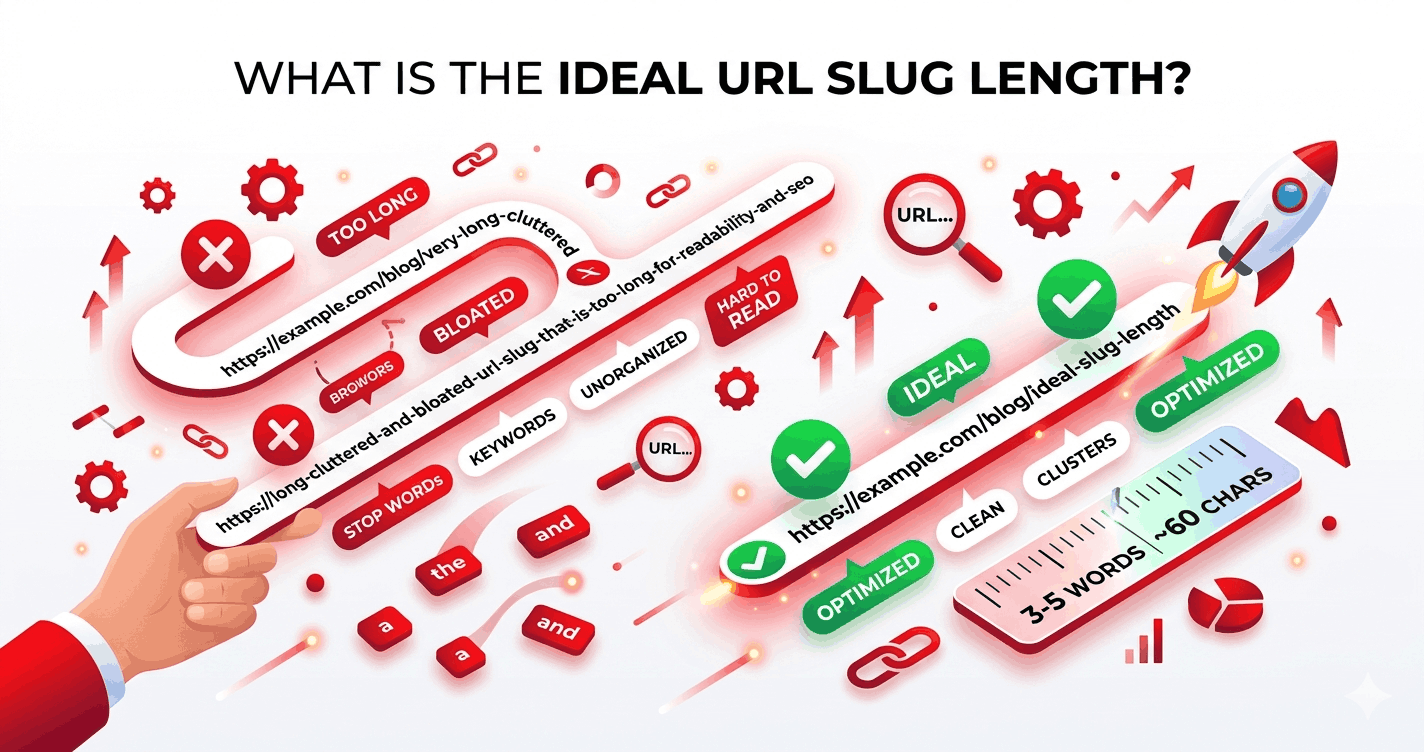
"How long should my URL slug be?" is one of the most common questions in on-page SEO — and the answer is refreshingly simple: shorter than you think. Let's look at what the ideal length actually is, why it matters, and how to tighten a bloated slug.
The short answer
Aim for a slug of three to five words, roughly under 60 characters. That's enough to be descriptive without becoming a sentence.
Too long:  /the-complete-step-by-step-beginners-guide-to-writing-seo-friendly-urls
Just right: /seo-friendly-urls-guide
Both describe the same page. The second is easier to read, share, and remember.
Why shorter slugs win
They're more readable
People scan URLs in search results and link previews. A short slug communicates the topic in a single glance; a long one forces the reader to wade through filler words.
They get truncated less
Search engines and browsers cut off long URLs with an ellipsis (…). If your keyword sits at the end of a 90-character slug, it may never be seen in the snippet.
They concentrate relevance
In a short slug, every word carries weight. Padding a slug with stop words and qualifiers dilutes the keywords that actually matter.
They're easier to share
Short slugs survive being typed by hand, read aloud on a podcast, or printed on a business card. Long ones get mangled.
Does length directly affect rankings?
Not dramatically on its own. Google has said URL length is not a major ranking factor. But length influences the things that do matter:
- Click-through rate — a clean, readable URL earns more clicks.
- Keyword prominence — shorter slugs keep keywords near the start.
- User trust — tidy URLs look more credible than sprawling ones.
So while you won't be penalized for a long slug, a short one quietly helps in several indirect ways.
How to shorten a slug without losing meaning
- Remove stop words. Drop the, a, and, of, to, in, for unless they change the meaning.
/the-best-tips-for-writing-a-blog-post → /blog-post-writing-tips - Cut redundant qualifiers. Words like complete, ultimate, step-by-step, beginners rarely need to be in the URL.
- Keep the core keyword. Whatever you trim, the primary term stays.
- Drop dates and years unless the date is the point of the page.
A few examples
| Title | Bloated slug | Ideal slug |
|---|---|---|
| The Ultimate Guide to On-Page SEO in 2026 | /the-ultimate-guide-to-on-page-seo-in-2026 |
/on-page-seo-guide |
| 15 Easy Recipes for Busy Weeknight Dinners | /15-easy-recipes-for-busy-weeknight-dinners |
/weeknight-dinner-recipes |
| How to Set Up Your First Email Newsletter | /how-to-set-up-your-first-email-newsletter |
/email-newsletter-setup |
What about very short slugs?
You can go too far. A one-word slug like /seo is short but vague and probably already taken on your site. The goal is descriptive and concise, not minimal for its own sake. Three to five meaningful words is the sweet spot.
The takeaway
The ideal URL slug is short, descriptive, and keyword-focused — usually three to five words and under 60 characters. Trim the filler, keep the meaning, and your URLs will read better and click better.
The easiest way to get a tight slug every time is to generate it automatically, which strips stop words and filler for you. For more, see the full slug best-practices checklist.