How to Create SEO-Friendly URL Slugs: 10 Best Practices
A practical checklist for writing SEO-friendly URL slugs: length, keywords, hyphens, stop words, and the mistakes that quietly hurt your rankings.
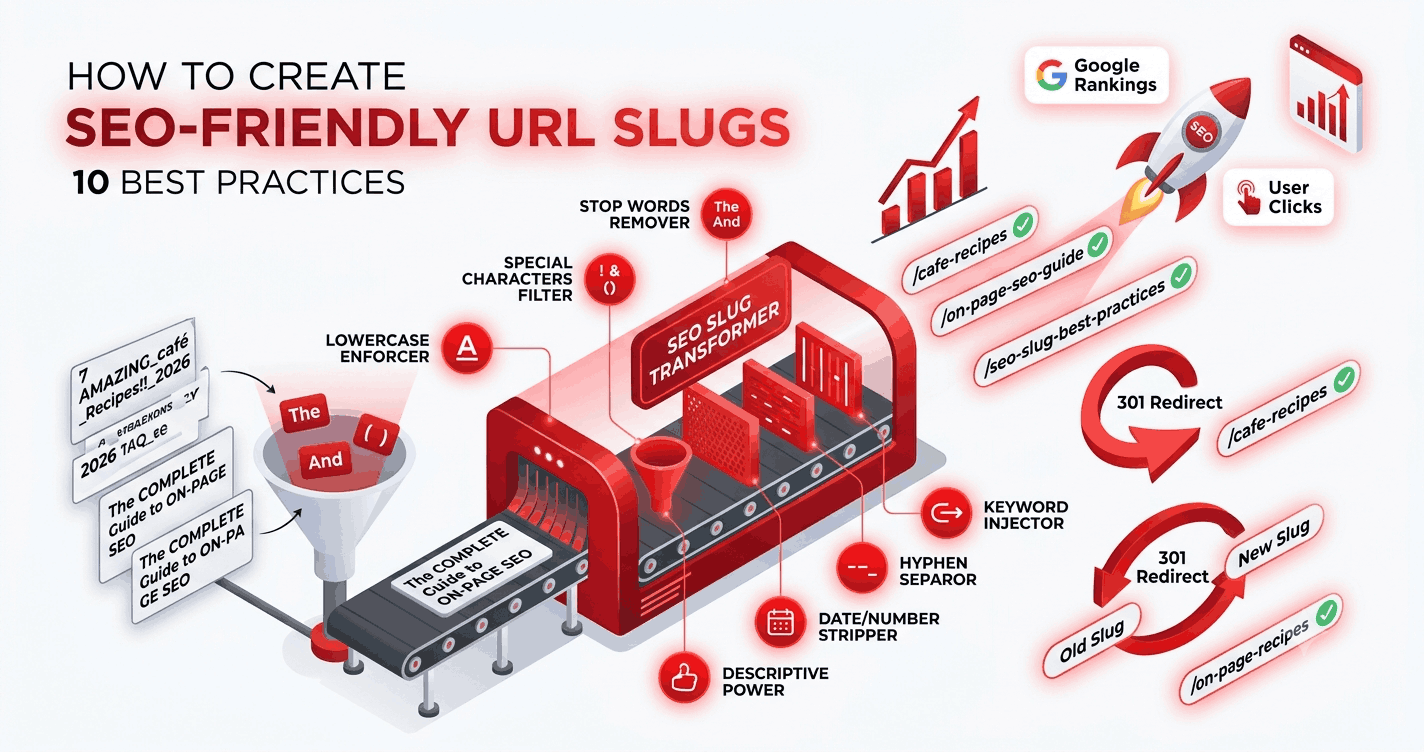
Your URL is one of the first things both Google and a potential visitor see. A clean, descriptive slug reinforces what your page is about; a messy one buries it under numbers and symbols. The good news is that writing SEO-friendly slugs comes down to a short, repeatable checklist.
Here are ten best practices, with examples you can apply today.
1. Keep slugs short and focused
Shorter URLs are easier to read, share, and remember — and they tend to perform better in search. Aim for three to five meaningful words.
Too long:  /the-complete-and-ultimate-beginners-guide-to-technical-seo-in-2026
Better:    /technical-seo-guide
Every extra word dilutes the important ones. Trim aggressively.
2. Include your target keyword
The slug is a small but genuine relevance signal. Put your primary keyword in it, ideally near the start.
Page about "vegan protein powder"
Weak:    /best-products-2026
Strong:  /vegan-protein-powder
Use the keyword once. Repeating it (/protein-powder-protein-best-protein) reads as spam.
3. Use hyphens, not underscores or spaces
Google treats hyphens as word separators and underscores as joiners. seo-friendly-url is read as three words; seo_friendly_url can be read as one. Spaces become ugly %20 codes.
Rule: always separate words with hyphens (-).
4. Stick to lowercase
Some servers treat /Guide and /guide as two different pages, which can split your link equity or create duplicate content. Force everything to lowercase and the problem disappears.
5. Remove stop words (carefully)
Small words like the, a, an, and, or, of, in, on rarely add meaning to a URL. Removing them tightens the slug:
Title:  The Best Tips for On-Page SEO
Slug:   /best-tips-on-page-seo
Keep a stop word only when dropping it changes the meaning (for example, "how-to" phrases).
6. Drop special characters and accents
Punctuation, emoji, and symbols either break the URL or get percent-encoded into noise. Accented letters should be converted to their base form so the slug stays clean and predictable:
Café & Crème! → /cafe-creme
Diseño Web    → /diseno-web
A dedicated generator handles this automatically; manual find-and-replace usually misses an edge case.
7. Make slugs descriptive, not generic
A reader should be able to guess the page content from the slug alone.
Generic:     /article-12
Descriptive: /url-slug-best-practices
Descriptive slugs also earn more clicks, because the URL in the search snippet looks relevant.
8. Avoid dates and volatile numbers
Putting /2026/ or /post-4471 in a slug ties the URL to a moment in time or an internal ID. When you update the article next year, the URL looks stale — or you're forced to redirect. Leave dates out unless they're essential to the topic.
9. Keep your structure consistent
Decide on a pattern and apply it everywhere: /blog/<slug>, /products/<slug>, /guides/<slug>. Consistency helps users predict URLs and helps search engines understand your site's hierarchy.
10. If you must change a slug, add a 301 redirect
Slugs accumulate value over time: backlinks, rankings, bookmarks. Changing one without a redirect throws that away and produces 404s. Whenever you rename a slug, set up a 301 redirect from the old URL to the new one.
A quick before-and-after
| Title | Before | After |
|---|---|---|
| 7 Amazing Café Recipes You'll LOVE!! | /7-Amazing-Café-Recipes-You'll-LOVE!! |
/cafe-recipes |
| The Ultimate Guide to URL Slugs (2026) | /the-ultimate-guide-to-url-slugs-2026 |
/url-slug-guide |
The fastest way to apply all ten rules
You don't have to remember this list every time you publish. Paste your title into Slugme.io and it applies lowercase, hyphenation, stop-word removal, accent conversion, and character cleanup in one click — entirely in your browser.
Want the theory behind it? Start with what a URL slug is, then settle the hyphens vs. underscores debate.