10 Common URL Slug Mistakes (and How to Fix Them)
From keyword stuffing to broken redirects, these URL slug mistakes quietly hurt your SEO. Here are 10 common slug errors and exactly how to fix each one.
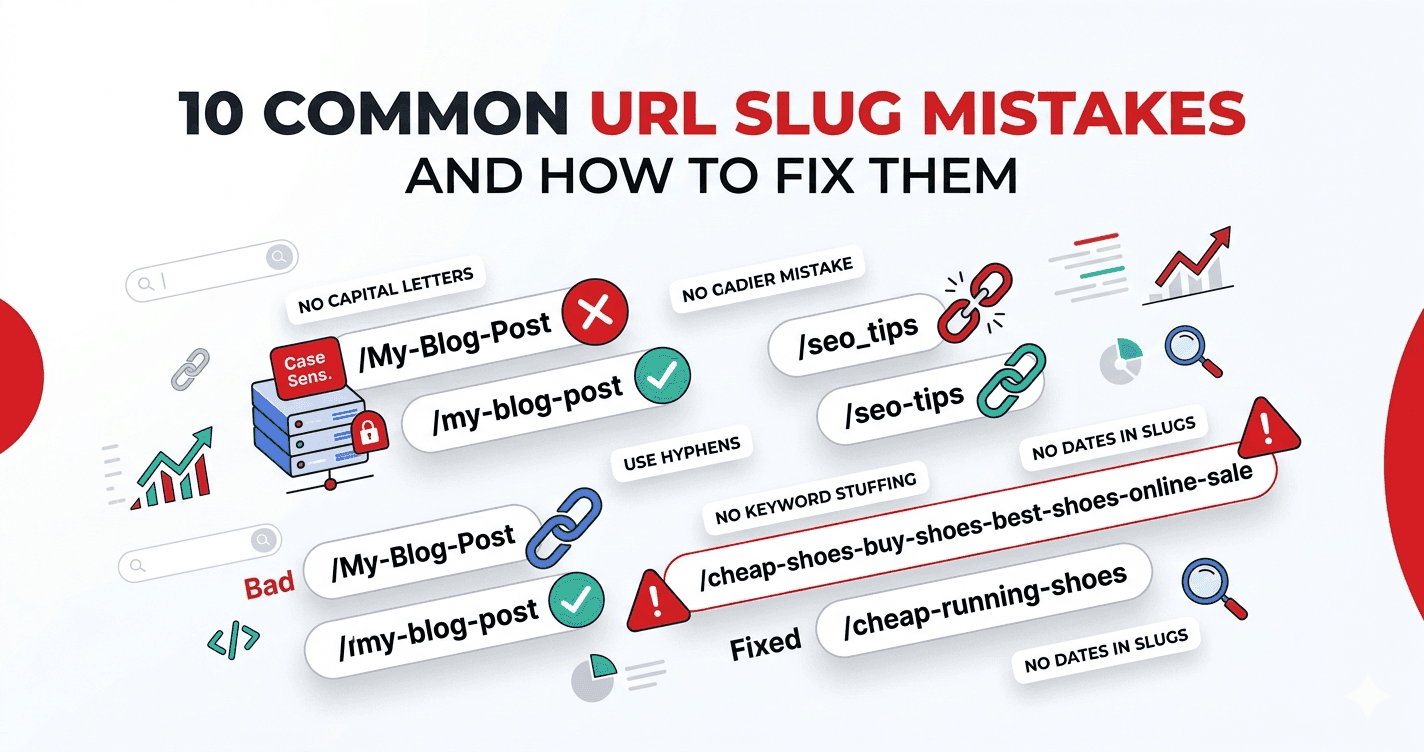
A bad slug rarely announces itself. It just quietly drags on your click-through rate, splits your rankings, or breaks a link nobody notices until traffic dips. Here are ten of the most common URL slug mistakes — and the fix for each.
1. Leaving capital letters in the slug
/My-Blog-Post invites duplicate content and broken links on case-sensitive servers.
Fix: lowercase everything, always. (See why URLs should be lowercase.)
2. Using underscores instead of hyphens
/seo_friendly_url can be read as a single word by search engines.
Fix: separate words with hyphens — /seo-friendly-url. (See hyphens vs. underscores.)
3. Stuffing keywords
/cheap-shoes-buy-shoes-shoes-online reads as spam and helps nothing.
Fix: include your main keyword once and stop. /cheap-running-shoes.
4. Making slugs too long
A 12-word slug gets truncated in search results and buries your keywords.
Fix: trim to three to five meaningful words. (See ideal slug length.)
5. Leaving special characters in
/mom's-best-pie-&-cake! becomes a percent-encoded mess.
Fix: strip punctuation, symbols, and emoji; convert accents to base letters. (See special characters in URLs.)
6. Using IDs and numbers with no meaning
/post?id=441 or /page-2847 tells readers and crawlers nothing.
Fix: use descriptive words — /url-slug-guide. (See dynamic vs. static URLs.)
7. Putting dates in the slug
/2026/03/my-post ages instantly and complicates future updates.
Fix: leave dates out unless the date is genuinely part of the topic.
8. Changing slugs without a redirect
Renaming a slug and skipping the redirect produces 404s and lost rankings.
Fix: always add a 301 redirect from old to new.
9. Inconsistent structure
Mixing /blog/post-one with /articles/post_two confuses users and search engines.
Fix: choose one pattern and apply it everywhere. (See SEO URL structure.)
10. Vague, generic slugs
/article-12 or /page-final-v2 could be about anything.
Fix: make the slug describe the content. A reader should guess the topic from the URL alone.
A quick before-and-after
| Mistake | Bad slug | Fixed slug |
|---|---|---|
| Caps + symbols | /Best-Café-Recipes! |
/best-cafe-recipes |
| Keyword stuffing | /seo-seo-tips-seo-guide |
/seo-tips |
| Too long | /the-complete-ultimate-guide-to-on-page-seo-2026 |
/on-page-seo-guide |
| Meaningless ID | /p?id=99 |
/running-shoes |
The easiest way to avoid all ten
Most of these mistakes come from writing slugs by hand and missing an edge case. A URL slug generator prevents them by default: it lowercases, hyphenates, strips special characters, converts accents, removes stop words, and keeps the slug short — in one click, in your browser.
The takeaway
The most common slug mistakes are capital letters, underscores, keyword stuffing, excess length, special characters, meaningless IDs, dates, missing redirects, inconsistency, and vagueness. Fix them with clean, lowercase, descriptive, hyphenated slugs — and a 301 redirect whenever you change one.