Stop Words in URLs: Should You Remove Them?
Should you remove stop words like 'the', 'and', and 'of' from your URL slugs? Here's what stop words are, when to cut them, and when to keep them.
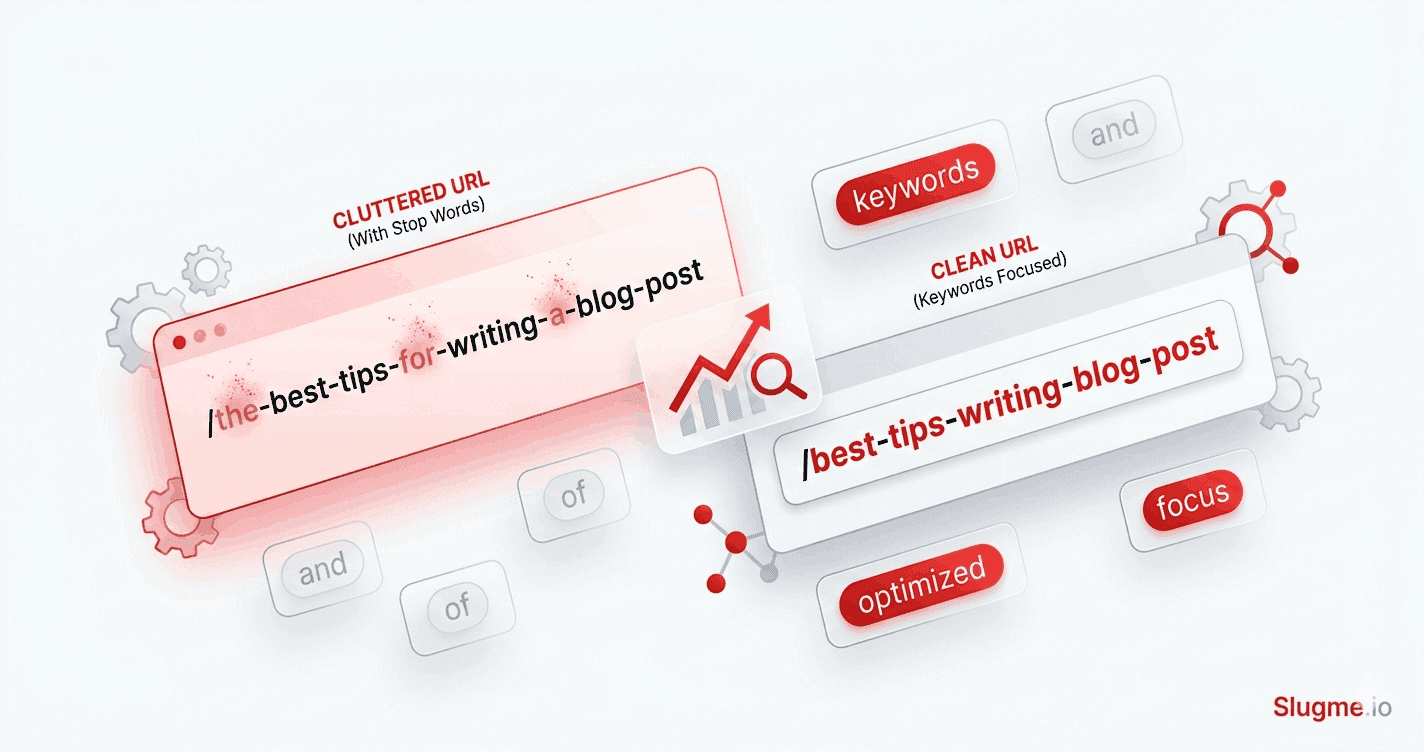
If you've ever generated a slug and wondered why "the" and "and" disappeared, you've met stop-word removal. It's a small step that makes URLs noticeably cleaner — but it's worth understanding when to use it and when to hold back.
What are stop words?
Stop words are the small, common words that glue a sentence together but carry little standalone meaning: the, a, an, and, or, but, of, to, in, on, for, with. In normal writing they're essential. In a URL slug, they're usually just clutter.
Compare:
With stop words:    /the-best-tips-for-writing-a-blog-post
Without stop words: /best-tips-writing-blog-post
The second version says the same thing in fewer, more meaningful words.
Why remove stop words from slugs?
Cleaner, shorter URLs
Stop words inflate a slug without adding information. Removing them gets you closer to the ideal slug length of three to five words.
Stronger keyword focus
A shorter slug concentrates attention on the words that matter. /blog-post-writing-tips puts the keywords front and center; /the-best-tips-for-writing-a-blog-post buries them.
Better readability
Tighter URLs are easier to scan in search results and easier to share.
Do stop words hurt SEO?
Not directly. Google understands language well and won't penalize a URL for containing "the." But stop words make slugs longer and less focused, which weakens the indirect benefits — click-through rate, keyword prominence, and shareability. Removing them is about polish and clarity, not avoiding a penalty.
When to keep stop words
Stop-word removal is a default, not a law. Keep a stop word when dropping it changes the meaning or makes the slug awkward:
- The word is part of a brand or title:
/the-north-face-reviewshouldn't become/north-face-reviewif "The North Face" is the exact brand. - Removing it creates ambiguity:
/how-to-codereads fine, but some phrases genuinely need their connectors. - It's a recognized phrase:
/state-of-the-art-designloses its meaning without "of the."
The test is simple: read the slug aloud. If it still makes sense and reads naturally, the stop words were safe to remove.
Stop words differ by language
English stop words won't help a French or Spanish URL. Each language has its own list:
- English: a, an, the, and, or, but, in, on, with
- French: le, la, les, un, une, des, et, de, du
- Spanish: el, la, los, las, un, una, y, de, del
This is why a language-aware generator applies the correct list automatically — something a simple find-and-replace can't do. (More on that in URL slugs for non-Latin languages.)
How to remove stop words automatically
Doing this by hand for every URL is tedious and error-prone. Slugme.io has a one-click "Remove stop words" toggle that strips the right words for your chosen language while leaving your keywords intact. Turn it off any time you need to preserve an exact phrase.
The takeaway
Removing stop words is a quick way to make slugs shorter, cleaner, and more keyword-focused. Use it as your default, but keep the small words whenever dropping them would change the meaning. Let the tool handle the per-language rules so you don't have to.