SEO URL Structure: A Practical Guide for 2026
A clear guide to SEO-friendly URL structure: folders, subdomains, hierarchy, and how to organize URLs so both users and search engines understand your site.
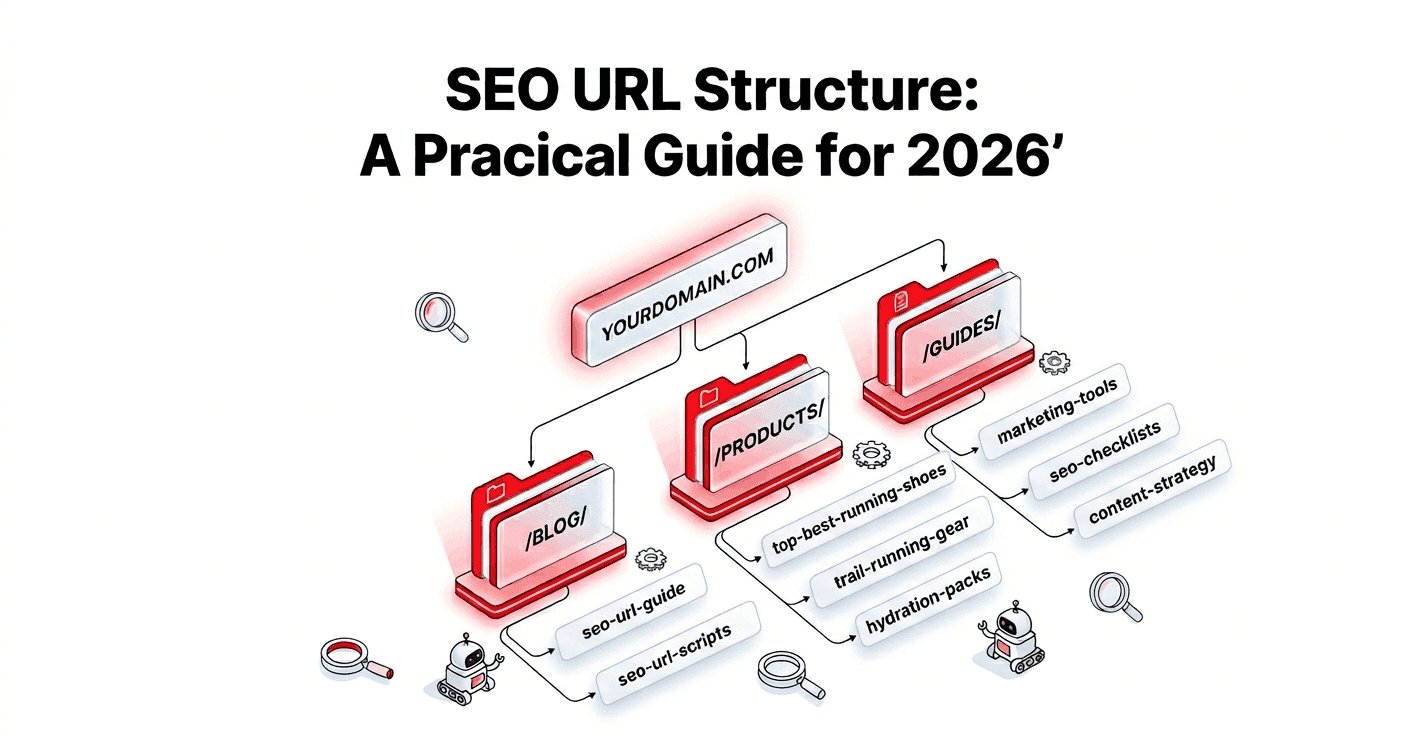
A single slug is one address; URL structure is the whole map. How you organize your URLs tells both users and search engines how your site is put together — what's a section, what's a sub-topic, and how pages relate. Get the structure right and your site becomes easier to crawl, navigate, and rank.
Here's a practical guide to building a clean URL structure.
What is URL structure?
URL structure is the pattern of folders and paths across your site. Compare two ways of organizing the same blog:
Flat:          /best-running-shoes
Hierarchical:  /blog/running/best-running-shoes
Both can work. The difference is that the hierarchical version communicates where the page sits — it's a blog post, in the running category.
Principles of good URL structure
1. Keep it shallow
Aim for a structure that's no more than two or three folders deep. Deeply nested URLs like /blog/2026/sports/running/shoes/reviews/best-of are hard to read and suggest the page is buried far from your homepage.
Too deep:  /products/footwear/running/mens/shoes/trail/best
Better:    /running-shoes/trail
2. Make it logical and predictable
A visitor should be able to guess a URL. If your blog lives at /blog/<slug>, every post should follow that pattern. Consistency helps users and helps search engines understand your hierarchy.
3. Use real words, not IDs
/products/blue-trail-shoes beats /products/sku-99214. Words describe; numbers don't. (See why keywords in URLs help.)
4. Match structure to navigation
Your URL folders should mirror how people actually browse your site. If your menu has Guides, Tools, and Blog, your URLs should too: /guides/..., /tools/..., /blog/....
5. Apply slug rules to every segment
Every part of the path is a slug. Each folder and page name should be lowercase, hyphenated, and free of special characters — the same best practices you'd apply to any slug.
Folders vs. subdomains
A common question: should a section be a folder (example.com/blog) or a subdomain (blog.example.com)?
- Folders keep everything under one domain, consolidating authority. This is usually the better choice for content like blogs and guides.
- Subdomains are treated more like separate sites. Reserve them for genuinely distinct properties (an app, a help center, a store on a different platform).
For most websites, folders are the safer, simpler default.
Should you include categories in URLs?
Category folders (/blog/seo/url-structure) add helpful context and keywords, but they also create a dependency: if you move a post to a new category, the URL changes and you'll need a 301 redirect.
- Use category folders when your taxonomy is stable and meaningful.
- Use flat slugs (
/url-structure) when posts are fluid or could belong to several categories.
Both are valid — just pick one pattern and stick to it.
Common structure mistakes
- Dates in the path (
/2026/03/post) age your content and complicate redirects. - Parameters where slugs belong (
/page?id=12&cat=4) — fine for filters, bad for primary content URLs. (See dynamic vs. static URLs.) - Inconsistent patterns —
/blog/post-onenext to/articles/post_twoconfuses everyone. - Trailing-slash inconsistency — pick one convention. (See trailing slashes explained.)
A simple, reliable blueprint
For most content sites, this structure works well:
/                       → homepage
/blog                   → blog index
/blog/<slug>            → individual posts
/<top-level-page>       → about, contact, pricing, etc.
Shallow, predictable, and easy to maintain.
The takeaway
Good URL structure is shallow, logical, word-based, and consistent. Mirror your navigation, apply clean slug rules to every segment, and prefer folders over subdomains for content.
When it's time to create the individual slugs that fill that structure, generate them in one click so each segment stays clean and consistent.