Slug vs. Permalink vs. Path: What's the Difference?
Slug, permalink, path, URL — these terms get mixed up constantly. Here's a clear, example-driven explanation of what each one means and how they relate.
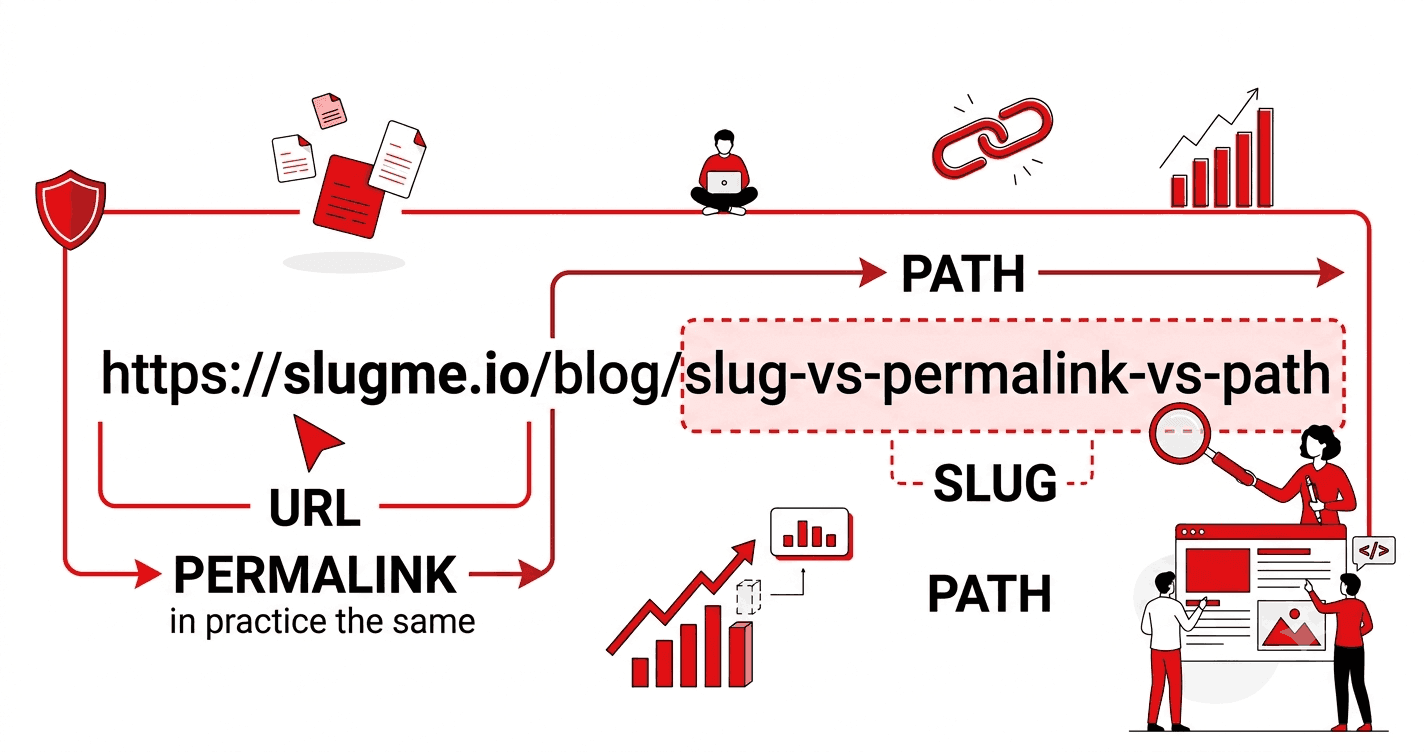
Slug, permalink, path, URL — if these words blur together, you're not alone. They describe overlapping parts of the same thing, which is exactly why they get confused. Let's untangle them with one example.
One URL, four terms
Take this address:
https://slugme.io/blog/slug-vs-permalink-vs-path
Here's how each term maps onto it:
- URL — the entire address:
https://slugme.io/blog/slug-vs-permalink-vs-path - Permalink — the permanent URL to a specific page (in practice, the same full address)
- Path — everything after the domain:
/blog/slug-vs-permalink-vs-path - Slug — the page-identifying segment:
slug-vs-permalink-vs-path
In one sentence: the slug is part of the path, the path is part of the URL, and the permalink is the full, permanent URL.
What is a slug?
A slug is the human-readable label that identifies a single page, usually the last segment of the path. It's the part you typically get to edit in your CMS.
/blog/slug-vs-permalink-vs-path
            └──────── slug ────────┘
A good slug is lowercase, hyphenated, short, and descriptive. (See what a URL slug is.)
What is a path?
The path is the full route to a page after the domain — it can include multiple folders plus the slug.
/blog/slug-vs-permalink-vs-path
└──────────── path ─────────────┘
The path describes where the page lives in your site's structure. (See SEO URL structure.)
What is a permalink?
A permalink is short for "permanent link" — the full URL meant to stay stable over time so people can link to it reliably. The word is most associated with WordPress, where "permalink settings" control how your URLs are built. In everyday use, a page's permalink is its full URL.
https://slugme.io/blog/slug-vs-permalink-vs-path
└──────────────── permalink ──────────────────────┘
The key idea is permanence: a permalink shouldn't change. If it must, you redirect the old one.
What is a URL?
The URL (Uniform Resource Locator) is the complete address, including the protocol:
https://  slugme.io  /blog/slug-vs-permalink-vs-path
protocol   domain              path
It's the umbrella term. Every permalink is a URL; every slug and path is a piece of one.
A quick reference
| Term | What it is | Example |
|---|---|---|
| URL | The whole address | https://slugme.io/blog/slug-vs-permalink-vs-path |
| Permalink | The permanent full URL to a page | https://slugme.io/blog/slug-vs-permalink-vs-path |
| Path | Everything after the domain | /blog/slug-vs-permalink-vs-path |
| Slug | The page-identifying segment | slug-vs-permalink-vs-path |
Why the distinction matters
When someone says "edit the slug," they mean the editable page label — not the whole URL. When someone says "the permalink changed," they mean the entire address moved (and probably needs a redirect). Using the right word prevents miscommunication between writers, SEOs, and developers.
The takeaway
The slug is the readable page label, the path is the route after your domain, and the permalink is the full permanent URL. Get the slug right and the rest of the URL falls into place — generate a clean one here in a single click.