Readable URLs: Why They Matter for User Experience
Clean, readable URLs aren't just for SEO — they build trust, improve usability, and earn clicks. Here's how human-friendly URLs improve user experience.
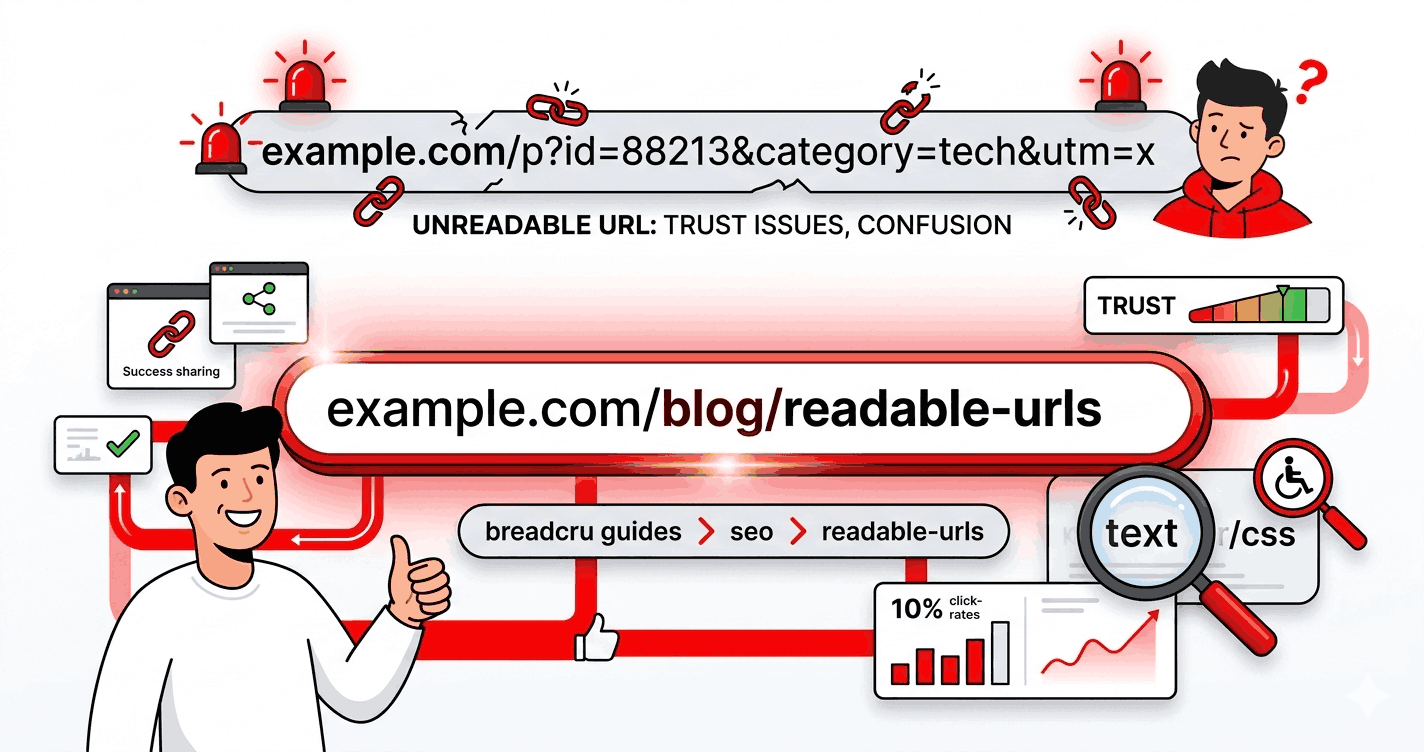
Most URL advice focuses on search engines. But there's another audience that reads your URLs constantly: people. A readable URL is a small usability feature that builds trust, aids navigation, and quietly earns clicks. Here's why human-friendly URLs matter and what makes one.
URLs are user interface
A URL isn't just a technical address — it's part of your interface. People see it in the address bar, in search results, in link previews, in shared messages, and when they hover over a link. Every one of those is a chance to either reassure the user or confuse them.
Compare:
/article?id=88213&ref=hp&sid=x9
/blog/readable-urls
The second tells the visitor exactly where they are and where a link will take them. The first is a black box.
How readable URLs improve UX
1. They build trust
Before clicking a link — especially from search or social — people glance at the URL to judge whether it's safe and relevant. A clean, descriptive URL looks trustworthy. A long string of numbers and parameters looks suspicious, even spammy.
2. They aid orientation
A readable URL acts like a breadcrumb. Seeing /guides/seo/readable-urls tells the user they're in a guide, in the SEO section. That sense of place reduces confusion and bounce.
3. They're predictable
When URLs follow a logical pattern, users can guess them. Someone on /blog/url-slug-guide can reasonably expect /blog to be the blog index. Predictable URLs make a site feel coherent and navigable.
4. They survive sharing
People share URLs by copying, typing, texting, and even reading them aloud. A readable slug like /email-newsletter-tips survives all of that; /p?id=4471&utm=x gets truncated, mistyped, or stripped.
5. They improve accessibility
Screen readers announce URLs. A clean, word-based slug is far more intelligible when read aloud than a string of IDs and percent-codes.
What makes a URL readable
The same qualities that help SEO help humans — which is no coincidence:
- Real words, not IDs —
/running-shoes, not/p441. - Lowercase and hyphenated — easy to scan and type.
- Short — three to five words, no truncation. (See ideal slug length.)
- No special characters — no
%20noise. (See special characters in URLs.) - Logical structure — folders that mirror navigation. (See SEO URL structure.)
The SEO and UX overlap
This is the happy part: optimizing URLs for humans and optimizing them for search engines are essentially the same job. Google's guidance pushes toward exactly the qualities that make URLs readable, because Google is trying to surface results people will find useful. Build URLs for people and the SEO follows.
The takeaway
Readable URLs are a genuine user-experience feature: they build trust, orient visitors, stay predictable, survive sharing, and improve accessibility. They also happen to be great for SEO. Use real words, keep them short and lowercase, and skip the special characters.
The fastest way to a human-friendly URL is to turn your title into a clean slug in one click.